EcoFlow DELTA 3 Max vs Bluetti Elite 200 V2: Which 2kWh Flagship Wins in 2026?
Two kilowatt-hours has settled in as the default size for serious portable power, and in 2026 the two units most people end up cross-shopping are EcoFlow’s DELTA 3 Max and Bluetti’s Elite 200 V2. On paper they look almost interchangeable: roughly 2kWh of LiFePO4, four AC outlets each, near-identical wall-charging speed. The differences that decide the purchase are somewhere else entirely.
Quick Answer
Get the Bluetti Elite 200 V2 if solar charging is a real part of your plan or you want the higher continuous output — it accepts 1,000W of solar input against the DELTA 3 Max’s 500W, delivers 2,600W continuous instead of 2,400W, and carries an explicit 6,000+ cycle rating. Get the EcoFlow DELTA 3 Max if you carry the unit regularly or run motor-driven equipment: it’s roughly nine pounds lighter, and its 4,800W surge ceiling plus X-Boost 3.0 (which stretches coverage to 3,400W devices) absorbs startup spikes that the Bluetti’s 3,900W Power Lifting mode won’t. Wall-charge speed is effectively a tie, so don’t let that be your tiebreaker.
Spec Comparison
| Spec | EcoFlow DELTA 3 Max | Bluetti Elite 200 V2 |
|---|---|---|
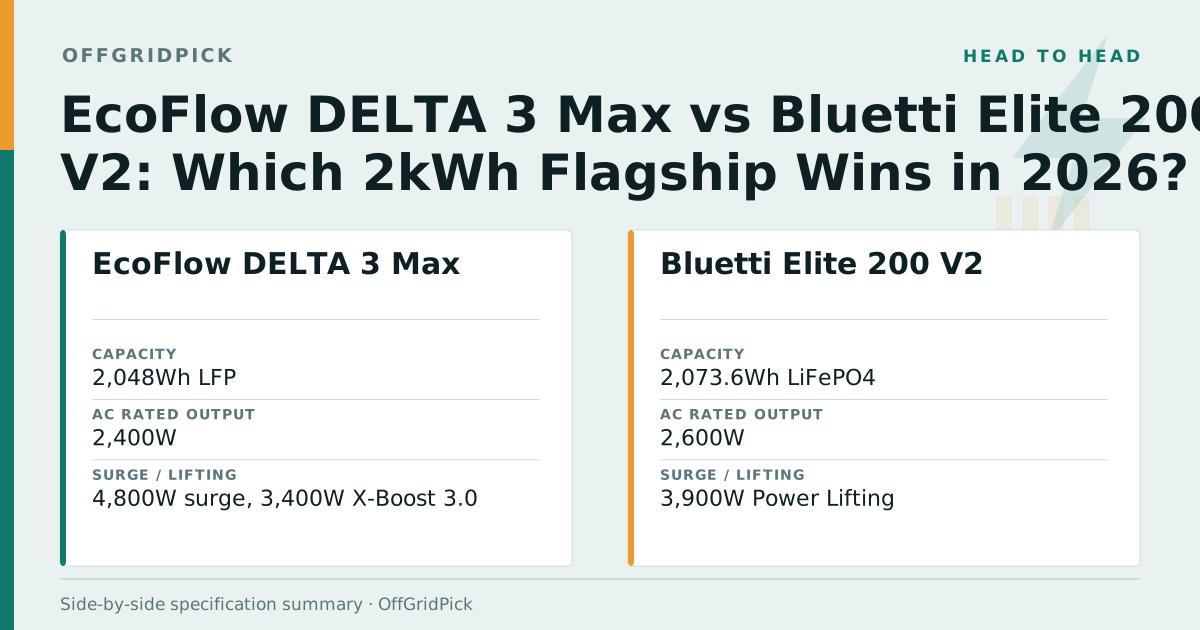
| Capacity | 2,048Wh LFP | 2,073.6Wh LiFePO4 |
| AC Rated Output | 2,400W | 2,600W |
| Surge / Lifting | 4,800W surge, 3,400W X-Boost 3.0 | 3,900W Power Lifting |
| Max Solar Input | 500W | 1,000W |
| Max AC Input | 1,800W | 1,800W |
| Charge to 80% | 68 minutes | About 1.1 hours |
| UPS Switchover | Under 10ms | 15ms or less |
| Published Cycle Rating | Designed for roughly a decade of service | 6,000+ cycles |
| AC Outlets | 4 | 4 |
| USB-C | 3 (one 100W, two 30W) | 2 x 100W |
| USB-A | 1 (18W) | 2 (15W each) |
| Car Port | 1 (126W) | 1 (12V/10A) |
| Weight | 20.3 kg (about 44.8 lb) | 24.2 kg (53.4 lb) |
| Dimensions | 494 x 239 x 305 mm | 13.78 x 9.84 x 12.74 in |
| Warranty | 5 years (3 + 2 with app registration) | 5 years |
Availability moves around, so check both directly: EcoFlow DELTA 3 Max and Bluetti Elite 200 V2.
The Solar Gap Is the Real Story
Everything else on that table is a matter of degrees. Solar input is a factor of two.
The Elite 200 V2 takes up to 1,000W across a 12V–60V window at 20A maximum. The DELTA 3 Max caps at 500W. If you’re building a system that lives off panels for days at a time, that difference compounds every single morning — the Bluetti can absorb a full array’s worth of midday production while the EcoFlow is still clipping. On a good day, one unit refills from sun in roughly half the time of the other.
That said, 500W is not a crippled number for weekend use. If your panels amount to a couple of 200W folding solar panels you set out at camp, both stations will swallow everything you produce. The gap only bites when you scale up. Our 200W solar panel guide covers what a realistic array looks like at this class, and if you’re leaning Bluetti, the panel pairing guide for Bluetti units is the more specific read.
Output: Higher Ceiling vs Higher Floor
This one splits cleanly, and most comparison charts get it backwards.
The Bluetti wins on sustained output. 2,600W continuous is 200W more than the EcoFlow, and that headroom shows up when you’re running several real loads at once — a space heater plus a coffee maker, or a full RV galley. Bluetti’s Power Lifting mode extends coverage to 3,900W devices by intelligently reducing delivered power to resistive loads.
The EcoFlow wins on peak. Its 4,800W surge rating is nearly a kilowatt above the Bluetti’s lifting figure, and surge is what matters when a compressor or an induction motor kicks over. A fridge that draws 150W running might spike far higher for a fraction of a second on startup. X-Boost 3.0 adds a second layer, letting the DELTA 3 Max run resistive devices rated as high as 3,400W by trimming voltage.
Practical translation: if your load list is heavy and steady, take the Bluetti. If your load list is spiky — power tools, compressors, well pumps — take the EcoFlow. For a broader look at what this capacity class handles, see our 2000Wh roundup.
Portability and Shape
Nine pounds sounds academic until you’re loading a truck bed. The DELTA 3 Max lands at 20.3 kg against the Elite 200 V2’s 24.2 kg, and that puts it in genuine one-person-carry territory where the Bluetti is more of a set-it-and-leave-it unit.
Shape matters too, in a way weight tables never show. The EcoFlow’s footprint is long and comparatively narrow; the Bluetti is squarer and shorter. In a packed trunk or a van cabinet, that difference decides whether the thing fits at all. Measure your space before you decide — this is the single most common regret in the class. Our van life picks go deeper on fitting power into tight builds.
Backup Duty and Longevity
Both units function as a UPS, and both switch fast enough for a desktop, router, or NAS to never notice a blackout: under 10ms on the EcoFlow, 15ms or less on the Bluetti. Neither number is a differentiator in practice — anything under about 20ms covers standard consumer electronics. Our UPS-capable station guide explains where that threshold actually matters.
Longevity is where Bluetti makes the louder claim. A 6,000+ cycle rating is unusually high even among LiFePO4 stations, where 3,000 to 4,000 is typical. EcoFlow frames the DELTA 3 Max in terms of a roughly decade-long service life rather than a raw cycle count, which is harder to compare directly. If you plan to cycle the battery daily — solar-first cabin, off-grid workshop — the explicit cycle figure is worth something. If it’s an emergency unit that gets used a dozen times a year, both will outlast your interest in them. See our LiFePO4 guide for how these ratings translate to real years.
FAQ
Is the Bluetti Elite 200 V2 more powerful than the EcoFlow DELTA 3 Max? In continuous output, yes — 2,600W vs 2,400W. In peak surge, no: the DELTA 3 Max’s 4,800W ceiling is higher than the Elite 200 V2’s 3,900W Power Lifting figure. Which one counts as “more powerful” depends entirely on whether your loads are steady or spiky.
Which charges faster from a wall outlet? Neither, meaningfully. Both accept 1,800W of AC input and reach 80% in roughly the same time — 68 minutes for the DELTA 3 Max, about 1.1 hours for the Elite 200 V2 with TurboBoost enabled. Treat wall charging as a tie.
Can the EcoFlow DELTA 3 Max handle 1,000W of solar panels? No. Its solar input is capped at 500W. Wiring a larger array won’t damage it, but you’ll never see more than 500W going in. If you want to use 1,000W of panels, the Elite 200 V2 is the correct choice of the two.
Is the DELTA 3 Max worth it over the Elite 200 V2 for camping? Often, yes — mostly because of weight and shape. At roughly nine pounds lighter it’s easier to move between vehicle and campsite, and campground solar setups rarely exceed the 500W input ceiling anyway. The calculus flips for a stationary basecamp with a big array.
Do both support expansion batteries? Bluetti lists expansion battery compatibility for the Elite 200 V2, which lets you grow total capacity later. If a guaranteed upgrade path matters to you, check our expandable power station guide before committing to either platform.
Conclusion
These two are closer than the marketing suggests, and the honest framing is that neither is a bad buy. The Elite 200 V2 is the better foundation for a solar-first system — double the panel input, higher continuous output, and a cycle rating you can point at. The DELTA 3 Max is the better travel companion and the safer bet for motor-driven loads, thanks to a surge ceiling the Bluetti simply doesn’t match.
Decide on those two axes and the choice makes itself. Still weighing brands more broadly? Our EcoFlow vs Bluetti breakdown covers ecosystem, app, and accessory differences across the whole lineup, and the DELTA 3 Plus review is worth a look if you’re wondering whether you need this much capacity at all.