EcoFlow DELTA 3 vs DELTA 2: What Actually Changed Between Generations?
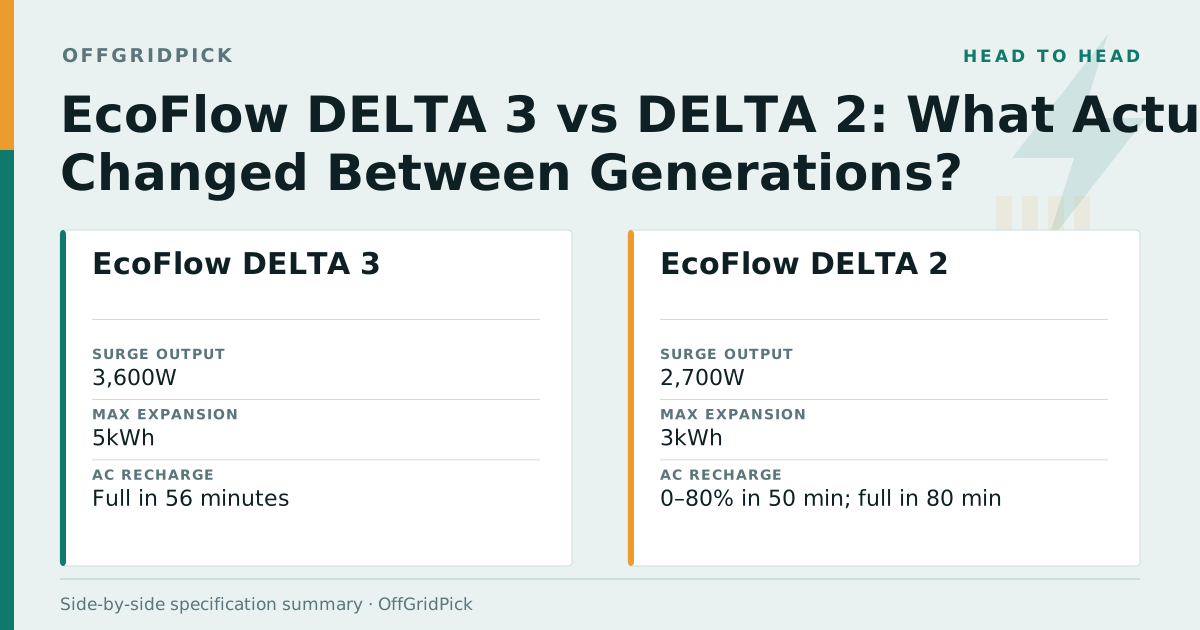
The DELTA 2 was the default recommendation in the 1kWh class for years, which makes the DELTA 3 a confusing upgrade at first glance — same capacity, same headline output. The changes are real, but they are hiding in the surge rating, the expansion ceiling, and the cycle count.
Quick Answer
Get the DELTA 3 if you want the better long-term unit: 3,600W surge instead of 2,700W, expansion to 5kWh instead of 3kWh, sub-10ms UPS switchover, a 56-minute full recharge, and 4,000 rated cycles instead of 3,000. Get the DELTA 2 only if it lands a full price tier below the DELTA 3 and your loads are modest — the battery capacity, the 1,800W inverter, the 500W solar ceiling, and the 5-year warranty are identical, so a discounted DELTA 2 is still a lot of power station. For anything with a hard startup spike or any plan to expand, the DELTA 3 is the correct answer.
Spec Comparison
| Spec | EcoFlow DELTA 3 | EcoFlow DELTA 2 |
|---|---|---|
| Battery capacity | 1,024Wh LiFePO4 | 1,024Wh LiFePO4 |
| AC output (continuous) | 1,800W | 1,800W |
| Surge output | 3,600W | 2,700W |
| X-Boost | Up to 2,200W | Up to 2,200W |
| Max expansion | 5kWh | 3kWh |
| AC recharge | Full in 56 minutes | 0–80% in 50 min; full in 80 min |
| Max solar input | 500W | 500W |
| UPS switchover | Under 10ms | Auto-switch on grid loss |
| Rated cycle life | 4,000 cycles to 80%+ | 3,000+ cycles |
| Weight | 27.6 lb | Comparable, slightly heavier body |
| AC outlets | 6 | 6 |
| Total output ports | 13 | 15 device capacity |
| Warranty | 5 years | 5 years |
Check current listings for both: EcoFlow DELTA 3 and EcoFlow DELTA 2.
The Surge Rating Is the Real Upgrade
Continuous output did not move. Both generations deliver 1,800W of pure sine wave, and that number is what most spec sheets lead with. It is also the number that matters least when comparing these two.
Surge capacity went from 2,700W to 3,600W — a 900W increase in the headroom available for the instant a motor kicks over. That instant is where power stations fail. A refrigerator compressor, a submersible pump, a shop vacuum, a circular saw: each one draws several times its running wattage for a fraction of a second at startup. A 900W wider surge window is the difference between a device that starts and a device that trips the inverter.
If you are shopping for a station to keep a fridge alive during outages, this is the spec that should drive the decision. We go deeper on that in our guide to running a refrigerator from a power station.
Note that X-Boost — EcoFlow’s trick for running resistive heating appliances above the rated output by lowering delivered voltage, described on EcoFlow’s DELTA 3 product page — sits at 2,200W on both generations. X-Boost handles kettles and hair dryers; the surge rating handles motors. They solve different problems, and only one of them improved.
Expansion: 3kWh vs 5kWh
The DELTA 2 accepts an extra battery to reach 2,048Wh, or a DELTA Max extra battery to reach roughly 3kWh, as EcoFlow’s DELTA 2 listing sets out. The DELTA 3 raises that ceiling to 5kWh.
Two kilowatt-hours of additional headroom sounds abstract until you translate it: 5kWh is roughly a full day of essential household loads — fridge, lights, router, phones, a few small appliances — where 3kWh runs out somewhere in the evening. For anyone treating a 1kWh unit as the starter piece of a backup system rather than the whole thing, the higher ceiling is a genuine reason to pick the newer generation. Our expandable power station guide covers how that ladder works across the market.
Charging, UPS, and Cycle Life
Recharge speed is close to a wash. The DELTA 3 hits a full charge in 56 minutes; the DELTA 2 reaches 80% in 50 minutes and full in 80. Both are fast enough that topping off is a lunch-break errand rather than an overnight commitment. Solar input caps at 500W on both, so if solar is your primary source, the two generations behave identically.
UPS is where the DELTA 3 pulls ahead in a way that matters to a narrow but real audience. Sub-10ms switchover is fast enough to keep a desktop PC, a NAS, or a networking rack from rebooting when the grid drops. The DELTA 2 switches automatically too, but the DELTA 3’s rated speed is the one you want behind sensitive equipment. If that’s your use case, our UPS-capable power station roundup is the relevant list.
Cycle life moved from 3,000+ to 4,000 cycles to 80% or better. On a station you cycle daily that is several extra years of service before meaningful degradation; on a station that sits in a closet waiting for outages, it is a number you will never reach with either unit.
Which One Should You Buy?
Home backup with a fridge involved. DELTA 3. The surge headroom and the 5kWh expansion ceiling both point the same direction.
Camping and road trips. Either. At this capacity you’re charging devices, running lights and a fan, maybe a portable fridge — loads that never approach the surge ceiling. Take whichever is cheaper. Our camping power station guide covers what actually matters in that context.
Remote work and sensitive electronics. DELTA 3, for the sub-10ms UPS. A monitor flicker is annoying; a NAS hard-reboot mid-write is not.
Value hunting. DELTA 2. Once a successor launches, the previous generation predictably settles into a lower price tier, and a discounted DELTA 2 is still a 1,024Wh LiFePO4 station with 1,800W output, six AC outlets, and a 5-year warranty. That is a strong package at a reduced price, and it’s why the DELTA 2 still shows up in comparisons like Anker Solix C1000 vs EcoFlow DELTA 2 and DELTA 2 vs Jackery Explorer 1000 v2.
Something bigger than 1kWh. Neither. Step up a class — our 2000Wh roundup covers that territory, and the DELTA 3 Plus review covers the mid-step sibling in this same series.
A Note on the DELTA 3 Naming
EcoFlow ships three units under the DELTA 3 banner and they are easy to confuse. The DELTA 3 is the standard model covered here: 1,024Wh, 1,800W, 3,600W surge, X-Boost to 2,200W, 500W solar, 56-minute full recharge. The DELTA 3 Classic shares the capacity and output but is tuned differently, with X-Boost rated up to 2,600W and a 45-minute 0–80% charge. The DELTA 3 Plus is the step-up variant with 1,500W AC input.
All three sit at 1,024Wh and 1,800W, so listings look nearly identical at a glance. Check the exact model name before you buy, because the differences live in the charging and boost specs rather than the headline numbers.
FAQ
1. Is the EcoFlow DELTA 3 worth upgrading to from a DELTA 2? If you already own a working DELTA 2, no. The capacity and continuous output are the same, and those are what you use daily. Upgrade only if you specifically need the 3,600W surge, the 5kWh expansion ceiling, or the sub-10ms UPS.
2. What is the difference between DELTA 3 and DELTA 2? Surge power (3,600W vs 2,700W), expansion ceiling (5kWh vs 3kWh), rated cycle life (4,000 vs 3,000+), and UPS switchover speed. Capacity, continuous output, solar input, and warranty are unchanged.
3. Do the DELTA 3 and DELTA 2 use the same expansion batteries? No — EcoFlow’s expansion batteries are matched to their host generation, and the DELTA 3 ecosystem tops out higher at 5kWh. Confirm compatibility for your exact model before buying an extra battery.
4. Is the DELTA 2 still a good buy? Yes, when it’s discounted a tier below the DELTA 3. The 1,024Wh LiFePO4 battery, 1,800W inverter, six AC outlets, and 5-year warranty haven’t changed. You’re giving up surge headroom and expansion room, not everyday capability.
5. Can either one run a refrigerator? Both can. The DELTA 3’s wider surge window makes it the safer bet with older or larger compressors that spike harder at startup. See our full breakdown on powering a refrigerator for runtime math.
6. How long does it take to charge either unit from solar? Both cap at 500W of solar input, so a full recharge takes roughly three to six hours depending on conditions. That spread is wide because panels rarely deliver their rated wattage — the Department of Energy’s overview of solar performance and efficiency covers the temperature and angle losses behind it. Solar performance is one area where the generations are genuinely identical.
Conclusion
This is a generational update that improved the edges rather than the middle. Capacity, continuous output, solar input, port count, and warranty all carried over unchanged — which is why a discounted DELTA 2 remains a legitimate purchase rather than a mistake.
What moved is headroom: more surge for motors, more expansion for longer outages, more cycles before degradation, and faster UPS switching for equipment that can’t tolerate a blink. If any of those describe your use case, take the DELTA 3. If none of them do, buy whichever one is cheaper the week you’re shopping.