EcoFlow DELTA Pro 3 vs Anker SOLIX F3800: Which Whole-Home Backup System Should You Wire In?
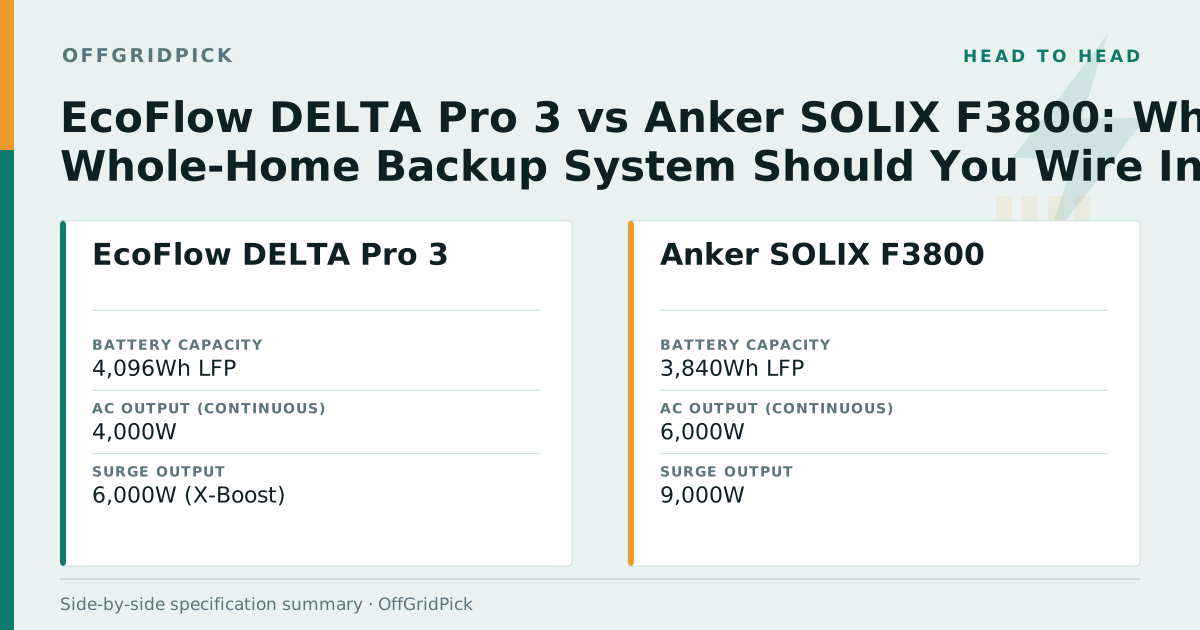
These are the two systems people actually cross-shop when they decide a portable power station should replace a standby generator. Both do 120V and 240V, both weigh more than a hundred pounds, and both are designed to be wired into a transfer switch rather than carried to a campsite.
Quick Answer
Get the EcoFlow DELTA Pro 3 if solar is central to your plan or you want maximum capacity per unit: 4,096Wh, 2,600W of solar input, and expansion to 48kWh in a single system. Get the Anker SOLIX F3800 if you need raw continuous output above all: 6,000W continuous with a 9,000W surge, versus the DELTA Pro 3’s 4,000W continuous — a 2,000W advantage that decides whether a well pump, an air conditioner, and a range can run simultaneously. The F3800 also gives you dedicated NEMA 14-50 and L14-30 240V outlets out of the box. The DELTA Pro 3 gives you more stored energy and more than double the solar intake.
Note: this comparison covers the standard F3800, not the separately sold F3800 Plus. Check the model designation on any listing before ordering.
Spec Comparison
| Spec | EcoFlow DELTA Pro 3 | Anker SOLIX F3800 |
|---|---|---|
| Battery capacity | 4,096Wh LFP | 3,840Wh LFP |
| AC output (continuous) | 4,000W | 6,000W |
| Surge output | 6,000W (X-Boost) | 9,000W |
| Voltage | 120V / 240V | 120V / 240V |
| 240V outlets | L14-30 plus 30A plug | NEMA 14-50 and NEMA L14-30 |
| 120V outlets | 7 AC outlets total | 6× NEMA 5-20 |
| Max solar input | 2,600W | 2,400W (2× 1,200W) |
| Max AC input | — | 1,800W |
| Max expansion (single unit) | 48kWh system | 26.9kWh (6 packs) |
| Two-unit configuration | Supported | 12kW / 53.8kWh |
| UPS switchover | Yes | Under 20ms |
| Rated cycle life | 4,000 cycles to 80% | 3,000+ cycles |
| Weight | 113.5 lb | 132.3 lb |
| USB-C | — | 3× 100W |
| Warranty | 5 years | 5 years |
Check availability for both: EcoFlow DELTA Pro 3 and Anker SOLIX F3800.
Continuous Output Is the F3800’s Trump Card
Six thousand watts continuous versus four thousand. That single line decides more of this matchup than anything else on the table.
Four thousand watts covers essential-loads backup comfortably: refrigerator, freezer, furnace blower, well pump, lights, networking, a few outlets. It starts getting tight the moment you want to run more than one large appliance at once — the classic failure case is a well pump kicking on while the HVAC is running while someone starts the microwave.
Six thousand watts is a different category. It’s enough continuous output to cover a 240V well pump and a central AC compressor without staging loads by hand, and the 9,000W surge gives you a very wide startup window for motors. If your backup plan involves “the house behaves normally during an outage” rather than “the fridge stays cold,” the F3800 is the unit built for it.
The F3800’s 240V hardware also arrives more complete. Anker’s SOLIX F3800 system page lists both a NEMA 14-50 and a NEMA L14-30 outlet, each rated to the full 6,000W. That covers the two connector types you’re most likely to need for an interlock kit, a transfer switch, or an RV pedestal, without hunting for adapters.
Capacity, Solar, and the Expansion Ladder
The DELTA Pro 3 answers back on the energy side.
Its 4,096Wh base capacity edges out the F3800’s 3,840Wh — a modest 256Wh gap that matters less than the two specs behind it. First, solar input: 2,600W versus 2,400W, with the full input breakdown published on EcoFlow’s DELTA Pro 3 page. Both are large arrays by portable-power-station standards, and both can meaningfully recharge a 4kWh battery inside a solar day. Second, and more importantly, the DELTA Pro 3 scales to a 48kWh system, roughly double the F3800’s 26.9kWh single-unit ceiling.
The nuance worth understanding: Anker’s headline 53.8kWh figure applies to a paired configuration of two F3800 units with a full complement of expansion batteries, which also gets you to 12kW of output. A single F3800 with six packs tops out at 26.9kWh. EcoFlow’s 48kWh is reached within a single DELTA Pro 3 system. So if your endgame is a very large battery bank on one unit, the DELTA Pro 3 gets there without buying a second inverter.
Cycle life goes to EcoFlow as well — 4,000 cycles to 80% capacity versus 3,000+. For a unit that cycles daily as part of a solar setup, that’s a real difference in service life. For one that sits charged waiting for storms, neither number will ever be tested. Our expandable power station guide covers how to think about growing a bank over time.
Which One Fits Your Setup?
Whole-home backup on a transfer switch. The F3800, for the 6,000W continuous and the ready-made 14-50 and L14-30 outlets. This is the scenario the unit was designed around, and the extra 2,000W is what lets you stop rationing which appliances run at once. Our home backup solar generator roundup covers the wider category.
Solar-first off-grid living. The DELTA Pro 3. Higher solar input ceiling, higher single-unit expansion ceiling, and better rated cycle life — the three things that matter when the battery cycles every single day rather than a few times a year. See our off-grid living guide for how these systems fit into a permanent setup.
RV and large trailers. Close call, leaning F3800 for the NEMA 14-50 outlet, which plugs directly into 50A RV infrastructure. Our RV solar generator guide covers the connector question in more detail.
Replacing a gas generator. Both qualify, and both bring the advantages that matter — no fuel storage, no fumes, near-silent operation, indoor-safe. That last point is not a small one; the EPA’s guidance on carbon monoxide in indoor air explains why an engine can never be sited in an attached garage or basement, which is exactly where these battery systems live. The F3800’s continuous output is closer to what a mid-size standby generator delivers. We compare the two approaches directly in portable power station vs gas generator.
You already decided on EcoFlow. Read our full DELTA Pro 3 review for the deeper single-unit breakdown, and the home backup power station roundup for context on where it sits in the field.
The Weight and Installation Reality
Neither of these is portable in any meaningful sense. The DELTA Pro 3 weighs 113.5 lb and the F3800 comes in at 132.3 lb including its wheels, in a chassis measuring roughly 27.6 by 15.3 by 15.6 inches. Both roll on built-in wheels, and both are two-person lifts onto anything above floor level.
Plan for a permanent or semi-permanent location: a garage, a utility room, a basement near the panel. Expansion batteries add substantial weight on top of the base unit, so whatever surface you choose needs to hold the full stacked system, not just the inverter. And if you’re wiring into a transfer switch or an interlock kit, budget for a licensed electrician — that portion of the install is not a spec-sheet decision.
FAQ
1. Is the Anker SOLIX F3800 better than the EcoFlow DELTA Pro 3? For continuous output, yes — 6,000W versus 4,000W, with a 9,000W surge and both major 240V outlet types included. For capacity, solar intake, single-unit expansion ceiling, and rated cycle life, the DELTA Pro 3 wins. Pick based on whether your constraint is instantaneous load or stored energy.
2. Can either one power a whole house? Both can cover essential circuits through a transfer switch. The F3800’s 6,000W continuous gets closer to genuinely normal household operation, including simultaneous large appliances. A single unit of either will not run an unrestricted all-electric home indefinitely without expansion batteries and solar.
3. How much can each system expand? The DELTA Pro 3 scales to 48kWh in a single system. A single F3800 reaches 26.9kWh with six expansion batteries; two paired F3800 units reach 53.8kWh and 12kW of output.
4. Do I need an electrician to install these? For plug-in use, no. For anything wired into your home’s panel — a transfer switch, an interlock kit, a Smart Home Panel — yes, and in most jurisdictions it’s required. The 240V outlets on both units are designed to feed that hardware.
5. Which charges faster from solar? The DELTA Pro 3 accepts up to 2,600W of solar input versus the F3800’s 2,400W across two 1,200W inputs. The difference is small enough that array size and sun conditions will dominate the outcome.
6. What is the difference between the F3800 and the F3800 Plus? They are separate SKUs with different configurations. Everything in this comparison refers to the standard F3800, so confirm the exact model designation on the listing before ordering.
Conclusion
The choice is unusually clean for two products this expensive. The Anker SOLIX F3800 is the higher-output machine — 6,000W continuous, 9,000W surge, both 240V outlet types included — and it’s the one to buy if your goal is a house that behaves normally when the grid drops. The EcoFlow DELTA Pro 3 is the higher-energy machine — more capacity, more solar intake, a 48kWh single-unit ceiling, and more rated cycles — and it’s the one to buy if the battery is going to work every day rather than wait for emergencies.
Decide which constraint you’re actually solving for: peak load, or stored energy. The answer picks the unit for you.