Jackery Explorer 2000 Plus vs 2000 v2: Expandable Powerhouse or Grab-and-Go?
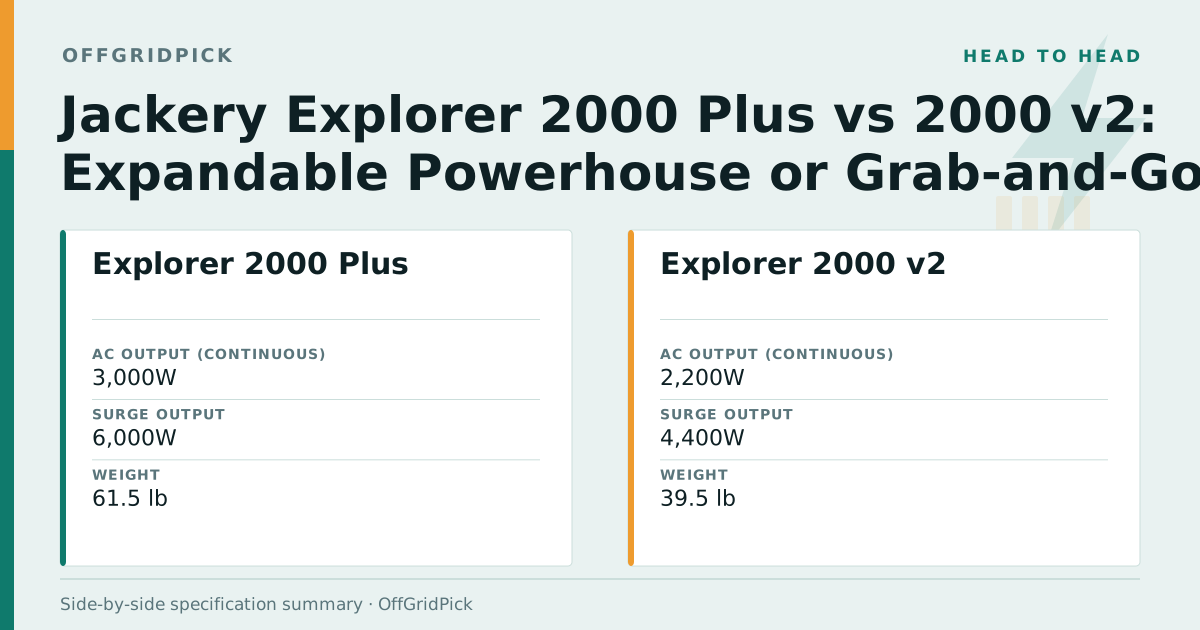
Two Jackery power stations, the same 2,042Wh LiFePO4 battery, and a 22-pound gap between them. That gap is the entire story: Jackery built the Explorer 2000 Plus to grow into a house backup system, and the Explorer 2000 v2 to be picked up and carried without recruiting a second person.
Quick Answer
Get the Explorer 2000 Plus if your power needs are going to grow — it puts out 3,000W continuous, accepts up to 1,400W of solar input, and chains with expansion battery packs to 12kWh on a single unit (or 24kWh and 240V when two units are linked). Get the Explorer 2000 v2 if you want two usable kilowatt-hours you can actually move: 39.5 lb against the Plus’s 61.5 lb, 2,200W continuous output, and no expansion path at all. The battery inside is identical. Everything built around it points in opposite directions.
Spec Comparison
| Spec | Explorer 2000 Plus | Explorer 2000 v2 |
|---|---|---|
| Battery capacity | 2,042Wh LiFePO4 | 2,042Wh LiFePO4 |
| AC output (continuous) | 3,000W | 2,200W |
| Surge output | 6,000W | 4,400W |
| Weight | 61.5 lb | 39.5 lb |
| Max solar input | 1,400W | 400W |
| AC recharge | Roughly 2 hours to full | 0–80% in 66 min; full in 102 min |
| Expansion batteries | Up to 5 packs, 12kWh single unit | Not supported |
| Two-unit configuration | 24kWh, 240V, 6,000W output | Not supported |
| AC outlets | 5 (four 20A, one 25A) | 3 |
| Rated cycle life | 4,000 cycles to 70% capacity | LiFePO4 rated for roughly a decade |
| UPS switchover | Yes | Under 20ms |
Availability changes constantly, so check both directly: Jackery Explorer 2000 Plus and Jackery Explorer 2000 v2.
The Expansion Question Decides This
Most head-to-heads come down to output or runtime. This one comes down to whether you ever want more than 2kWh.
The Explorer 2000 Plus is the only Jackery in this class built as a modular system. Add expansion packs — Jackery’s Explorer 2000 Plus page lists the compatible ones — and a single unit climbs from roughly 2kWh to 12kWh. Link two Plus units together with the full complement of packs and you reach 24kWh, unlock 240V output, and double continuous output to 6,000W — which is the territory where a power station stops being a camping accessory and starts substituting for a standby generator during an outage.
The Explorer 2000 v2 has none of that. What you buy is what you own, forever. That is not a flaw so much as a design decision: Jackery stripped out the expansion ports and the heavy 240V-capable inverter hardware, and the unit came out 22 pounds lighter as a result.
So the honest question is not “which is better.” It is “will 2,042Wh ever be enough?” If the answer is yes and always yes, the v2’s weight advantage is free money. If there is any chance you’ll want a whole-day or multi-day reserve, buying the v2 means buying twice. Our expandable power station guide covers how modular systems compare across brands if you want the wider view.
Solar Charging Is the Other Big Split
The 1,400W versus 400W solar input ceiling is the spec most people skim past, and it changes what off-grid life looks like with each unit.
At 1,400W of input, the Explorer 2000 Plus can refill a fully drained 2kWh battery inside a normal solar day with room to spare — you feed it a large array, it drinks all of it. That matters for van builds, RV setups, and off-grid cabins where the station is the daily energy hub, not a backup box.
The v2’s 400W ceiling — confirmed on Jackery’s Explorer 2000 v2 page — means a full solar recharge takes the better part of a good day. Jackery rates a solar refill at roughly six hours with 400W of panels under decent conditions, which is fine for a weekend where you’re topping off rather than cycling the whole battery, and genuinely limiting if you’re running a fridge and drawing the pack down every night. If solar is your only input source, that ceiling is the number to look at, not the capacity. We break down panel pairing in our guide to the best solar panels for Jackery.
Output Headroom: 3,000W vs 2,200W
Both stations clear the bar for the appliances most people care about. A refrigerator, a CPAP, a microwave, a coffee maker, laptops, lights — the 2,200W v2 handles all of it without complaint, and its 4,400W surge absorbs compressor startup spikes.
The 3,000W Plus earns its extra output in two situations. First, high-draw resistive loads: space heaters, hair dryers, full-size electric kettles, and 15A power tools that sit close to the 2,200W line and leave the v2 no margin for anything else running simultaneously. Second, multiple heavy loads at once — a well pump plus a fridge plus a heater is the classic outage scenario that separates a 3,000W inverter from a 2,200W one.
If you’re not sure which side of that line your household sits on, our guide on what size portable power station you need walks through the arithmetic with real appliance draws.
Which One Fits Your Use Case?
Camping and road trips. The v2, easily. Sixty-one pounds is a two-hands-and-a-grunt lift that you will resent every time it goes in and out of a vehicle; 39.5 lb is a single-person carry. Neither is backpacking equipment, but only one of them is a realistic car-camping companion.
Home backup. The Plus. Weight stops mattering the moment the unit lives in a utility room, and the expansion path plus 240V pairing is exactly what home backup buyers eventually want. See our home backup roundup for how it stacks against other systems in that role.
RV and van life. Depends on your solar array. Running 800W or more of panels on the roof? The Plus is the only one of the two that can actually absorb it. Running 200–400W? The v2 saves you 22 pounds and matches your input anyway.
Job sites. The Plus, for the 3,000W inverter and the fifth 25A outlet. Tools spike hard, and headroom is what keeps the inverter from cutting out mid-cut.
A single “power outage insurance” purchase. The v2 is the cleaner answer for a household that wants the fridge and the router alive for a day and nothing more elaborate. Our full Explorer 2000 v2 review goes deeper on that use case, and the 2000Wh class roundup shows the competition at this capacity.
FAQ
1. Is the Jackery Explorer 2000 Plus worth it over the 2000 v2? It is if you want expansion, 240V capability, or high-wattage solar input. Those three things are what the extra money and the extra 22 pounds buy you. If none of them apply to you, the Plus is a heavier unit with the same battery.
2. Do the Explorer 2000 Plus and 2000 v2 have the same battery capacity? Yes. Both are rated at 2,042Wh with LiFePO4 chemistry. Capacity is the one spec they genuinely share.
3. Can I add an expansion battery to the Jackery Explorer 2000 v2? No. The v2 does not support expansion packs. If your capacity needs might grow, that limitation is the strongest argument for the Plus.
4. How much faster does the Explorer 2000 Plus charge from solar? The Plus accepts up to 1,400W of solar input versus the v2’s 400W ceiling — roughly three and a half times the input. In practice the Plus can refill a drained battery in a single solar session, while the v2 needs most of a good day at its rated 400W.
5. Which one is better for running a whole house? The Plus, and only in a paired configuration. Two linked units with expansion batteries reach 24kWh with 240V output and 6,000W continuous, which is enough to cover essential circuits. A single unit of either model is an essential-loads solution, not a whole-house one.
6. Is the Explorer 2000 v2 too heavy for camping? At 39.5 lb it is a one-person lift and fine for car camping, but it is not something you carry any real distance. For hiking-scale trips, look at the lightweight backpacking class instead.
Conclusion
Jackery gave these two stations the same heart and opposite bodies. The Explorer 2000 Plus is a platform — 3,000W of output, 1,400W of solar intake, and a path to 24kWh that ends with a genuinely capable home backup system. The Explorer 2000 v2 is a finished product: lighter by 22 pounds, quick to recharge from the wall, and honest about being a fixed 2kWh box.
Buy the Plus if you’re building toward something. Buy the v2 if you already know exactly what you need and 2,042Wh is it.