Best 200Wh Portable Power Station: Small Enough to Actually Carry
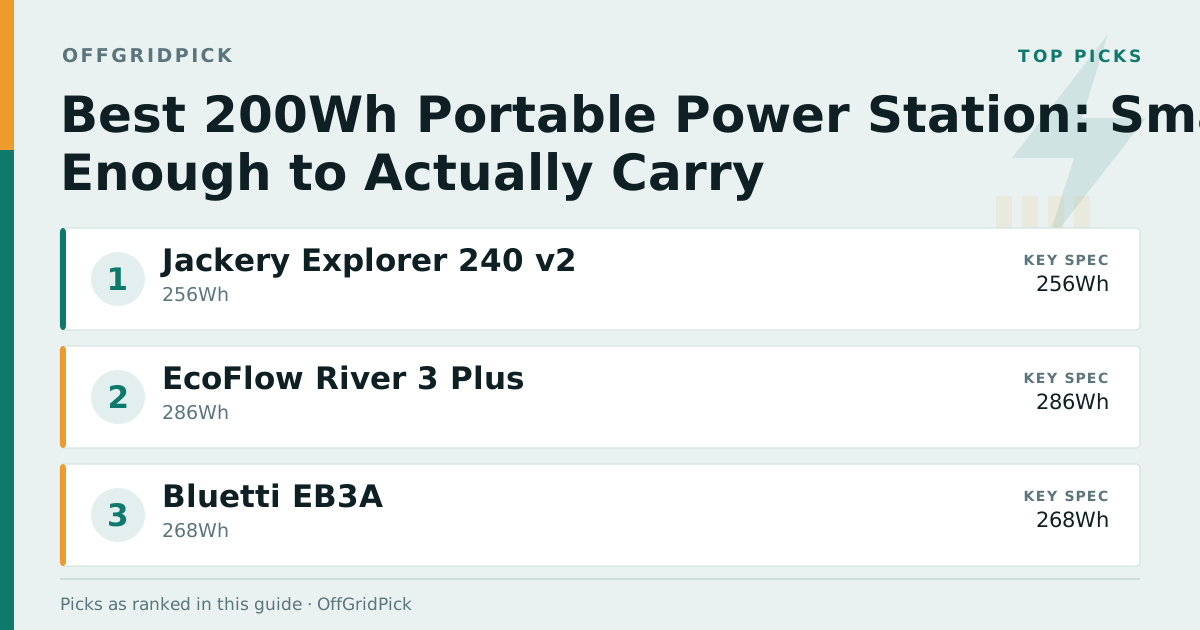
Best 200Wh Portable Power Station: Small, Light, and Genuinely Portable
Most “portable” power stations are portable the way a packed cooler is portable — technically, briefly, with regret. The 200Wh class is where the word starts meaning something: units under about 11 pounds that ride in a backpack, behind a car seat, or in a carry-on-adjacent tote, while still charging laptops, cameras, drones, and phones for days. Here’s how the current small-class contenders from Jackery, EcoFlow, Bluetti, and Anker compare on published specs.
Quick Answer
The Jackery Explorer 240 v2 is the best 200Wh-class portable power station for most people: 256Wh of LiFePO4 capacity, 300W of AC output, and a weight around 7.7 lbs — the best balance of energy per pound in the class. Pick the Bluetti EB3A if you want the most inverter power in a small package (600W), or the Jackery Explorer 100 Plus if you need something flight-legal at 99Wh and barely over 2 lbs.
The Small Class Compared
| Model | Capacity | Chemistry | AC Output | Weight | Standout Trait |
|---|---|---|---|---|---|
| Jackery Explorer 240 v2 | 256Wh | LiFePO4 | 300W | ~7.7 lbs | Best capacity-to-weight balance |
| EcoFlow River 3 Plus | 286Wh | LiFePO4, 3,000 cycles to 80% | 600W (X-Boost 1,200W) | 10.4 lbs | Fast AC recharge |
| Bluetti EB3A | 268Wh | LiFePO4 | 600W (1,200W surge) | ~10 lbs | Strongest surge handling |
| Anker Solix C300 | 288Wh | LiFePO4 | 300W | ~9.3 lbs | Most capacity in the class |
| Jackery Explorer 100 Plus | 99Wh | LiFePO4 | 128W | ~2.1 lbs | Airline carry-on legal |
Every unit here uses LiFePO4 chemistry — the small class fully made the transition, so cycle-life ratings in the thousands are now table stakes even at this size.
Detailed Breakdown
Jackery Explorer 240 v2 — Best Overall
The 240 v2 is the modern successor to one of the most popular small stations ever made, and the update fixed the old model’s two real weaknesses: it moved to LiFePO4 cells with a multi-thousand-cycle rating and added USB-C charging. You get 256Wh and a 300W inverter at around 7.7 lbs — light enough that bringing it stops being a decision.
Best for: Campers, van dwellers, and remote workers who want the least weight per watt-hour without giving up an AC outlet.
Limits: The 300W inverter covers laptops, CPAPs, lights, and camera gear, but not heat-producing appliances. That’s the class, not the unit.
EcoFlow River 3 Plus — Fastest to Refill
EcoFlow’s small-class entry brings the company’s signature trick down to size: high-wattage AC input that refills the battery in about an hour. With 286Wh, a 600W inverter, and X-Boost stretching resistive loads to 1,200W, it’s the most capable all-rounder here — at the cost of being the heaviest, at 10.4 lbs. Our EcoFlow River 3 review digs into the platform in detail.
Best for: Anyone who tops up between stops — road trippers, tailgaters, weekend photographers working out of a car.
Bluetti EB3A — Small Body, Big Inverter
The EB3A’s pitch is inverter muscle: 600W continuous with 1,200W surge from a unit around 10 lbs, plus a 15W wireless charging pad on top and solar input for off-grid refills. Capacity sits at a healthy 268Wh. It gives up polish to the newer designs, but the power-per-size ratio remains excellent.
Best for: Budget-tier shoppers who want the widest appliance compatibility a small station can offer.
Anker Solix C300 — The Capacity Play
Anker’s C300 carries 288Wh — the most storage in the group — with a 300W inverter and the brand’s typically strong USB-C implementation for fast-charging laptops directly. At about 9.3 lbs it slots between the Jackery and the Bluetti on weight.
Best for: USB-first users: multiple laptops, tablets, camera batteries, and drones, where high-wattage USB-C matters more than AC output.
Jackery Explorer 100 Plus — The Flight-Legal Ultralight
The Explorer 100 Plus is a different animal: 99Wh, deliberately one watt-hour under the FAA’s 100Wh carry-on limit, at about 2.1 lbs. There’s no AC inverter to speak of beyond its 128W total output — this is a USB-C powerhouse shaped like a power station. For backpackers and flyers, that’s exactly the point.
Best for: Air travelers and ultralight backpackers. It’s the only unit here that boards a plane with you.
Check current availability: Jackery Explorer 240 v2, Bluetti EB3A, Anker Solix C300, Jackery Explorer 100 Plus.
What a 200Wh-Class Station Actually Runs
Working from published capacities and typical device draws:
- Phone (about 15Wh): 13-16 charges from the mid-size units
- Laptop (about 60Wh): 3-4 charges
- Drone batteries (about 60Wh each): 3-4 charges
- CPAP without humidifier: most of a night — check your machine’s draw first
- LED lantern (5-10W): several evenings of light
The honest framing: this class powers devices, not appliances. If your list includes a fridge or anything with a heating element, start at least one size up — our guide on what size power station you need walks through the math, and our 500-watt roundup covers the next class.
How to Choose in This Class
- Weight is the feature. The entire reason to buy small is that you’ll actually bring it. If a unit’s weight makes you hesitate, it’s the wrong unit.
- Match the inverter to your worst device. A 300W inverter covers nearly all electronics; you only need the 600W units for occasional small-appliance duty.
- USB-C wattage matters more here than AC. In this class you’ll charge most gear over USB-C. Higher-wattage ports mean fewer adapters and faster refills.
- Solar input keeps small batteries useful. A modest panel can refill a 250Wh battery in an afternoon — our foldable solar panel guide covers portable pairings.
- Flying changes everything. Only sub-100Wh units are carry-on legal. Everything else in this guide travels by road.
For the hiking-specific angle on this same size class, see our small power stations for hiking guide and our lightweight backpacking roundup.
FAQ
1. What does “200Wh class” actually cover? Roughly 99Wh to 300Wh — units built around portability first. The sweet spot for most buyers sits at 250-290Wh, where you get multi-day device charging under 11 lbs.
2. Can I take a 200Wh power station on a plane? No — the FAA caps carry-on lithium batteries at 100Wh (up to 160Wh with airline approval). That’s exactly why the 99Wh Jackery Explorer 100 Plus exists.
3. Will a 200Wh-class station run a mini fridge? A 12V camping fridge, yes, for roughly 5-7 hours depending on the model and weather. A household mini fridge is a poor match — the compressor surge and daily draw both want a bigger battery.
4. How long do these small stations last? Every current model here uses LiFePO4 cells rated for thousands of charge cycles — the same chemistry as full-size stations. Small no longer means short-lived.
5. Is a power bank better than a small power station? If you only charge phones and tablets, a big power bank is lighter and cheaper. The power station earns its place the moment you need an AC outlet, higher-wattage USB-C, or solar input.
Conclusion
The Jackery Explorer 240 v2 wins the class by refusing to compromise on the one spec that defines it: weight per watt-hour. The EcoFlow River 3 Plus and Bluetti EB3A are the picks when you want small-station convenience with bigger-station output, the Anker Solix C300 is the USB-C specialist, and the Explorer 100 Plus stands alone as the one that flies. Whichever direction you lean, this class has quietly become the best first power station most people can buy — light enough to use constantly, capable enough to matter.