Bluetti AC200L vs Elite 200 V2: Is the Older Flagship Still the Smarter Buy?
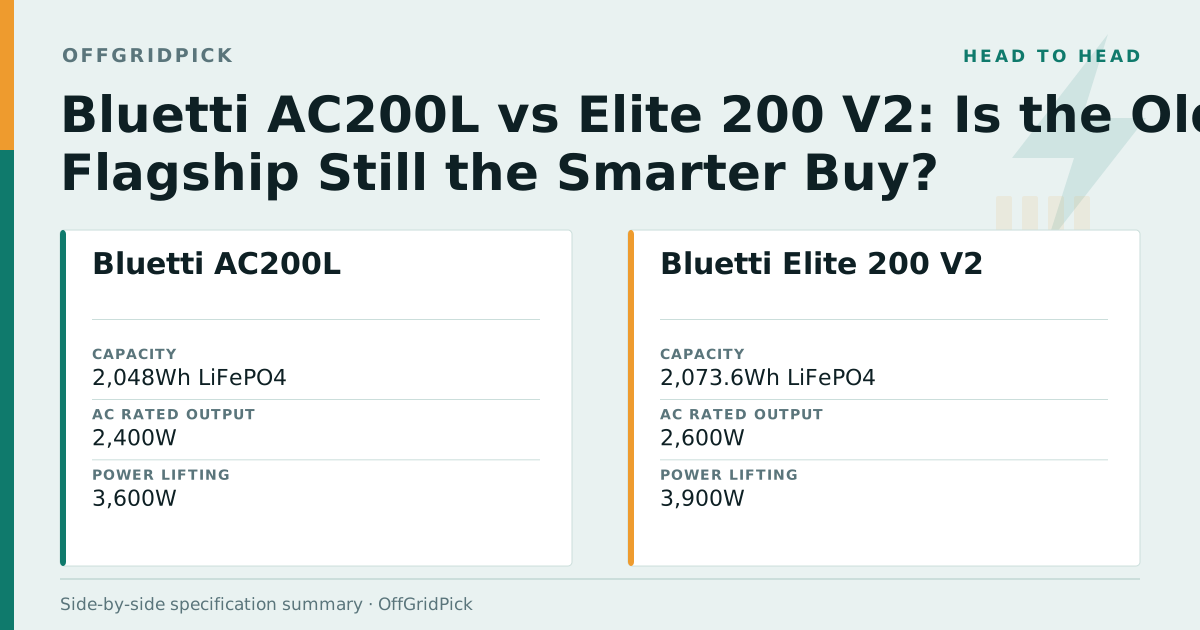
Most generational comparisons are boring because the new model simply wins. This one isn’t. Bluetti’s AC200L is the older 2kWh flagship and the Elite 200 V2 is the newer one, but the older unit takes more solar, charges faster from the wall, and expands to a far bigger system. Whether that makes it the better buy depends on exactly one question about how you plan to use it.
Quick Answer
Get the Bluetti AC200L if you’re building a system: it accepts 1,200W of solar, refills to 80% in 45 minutes on a 2,400W AC input, carries a 30A RV output, and expands well past 7kWh with Bluetti’s add-on batteries. Get the Elite 200 V2 if you’re buying a self-contained unit you’ll live with for a decade: it’s about eight pounds lighter, physically smaller, pushes 2,600W continuous instead of 2,400W, and is rated for 6,000+ cycles against the AC200L’s 3,000+. Systems builders take the old one. Everyone else takes the new one.
Spec Comparison
| Spec | Bluetti AC200L | Bluetti Elite 200 V2 |
|---|---|---|
| Capacity | 2,048Wh LiFePO4 | 2,073.6Wh LiFePO4 |
| AC Rated Output | 2,400W | 2,600W |
| Power Lifting | 3,600W | 3,900W |
| Max Solar Input | 1,200W | 1,000W |
| Max AC Input | 2,400W | 1,800W |
| Charge to 80% | 45 minutes | About 1.1 hours |
| Cycle Rating | 3,000+ cycles to 80% | 6,000+ cycles to 80% |
| Expansion | To 7,577.6Wh via B300K / B500K / B210 | Supported |
| RV Output | 30A (NEMA TT-30) | None |
| Notable DC | 48V/8A DC port | 12V/10A car port |
| USB-C | 2 x 100W | 2 x 100W |
| Noise | 50dB or less | — |
| Weight | About 61.6 lb (28 kg) | 53.4 lb (24.2 kg) |
| Dimensions | 16.5 x 11 x 14.4 in | 13.78 x 9.84 x 12.74 in |
| Warranty | 5 years | 5 years |
Current listings for both: Bluetti AC200L and Bluetti Elite 200 V2.
Where the Older Unit Still Wins
Charging speed. The AC200L takes 2,400W of AC input against the Elite 200 V2’s 1,800W, and that translates directly: 45 minutes to 80% versus roughly 1.1 hours. In a storm-outage scenario where you’re grabbing every minute of grid power between cuts, that’s not a small thing. See our fast-charging roundup for how that ranks against the wider field.
Solar input. 1,200W versus 1,000W. Not the chasm you see between brands, but it’s still 20% more panel capacity, and it’s the wrong direction for a newer model to move.
Expansion. This is the AC200L’s clearest structural advantage. Bluetti lists it as expandable to 7,577.6Wh using B300K, B500K, or B210 expansion batteries — meaning the same head unit can grow into something closer to a home battery bank. The Elite 200 V2 supports expansion too, but the AC200L’s published ceiling is the one to beat if whole-home ambitions are anywhere in your future. Our expandable station guide covers what that upgrade path actually costs.
The 30A RV output. A NEMA TT-30 socket on the unit means you plug your trailer’s shore power cord straight in. No adapters, no dogbone, no improvisation. The Elite 200 V2 has no equivalent. For RV owners this single port can settle the entire comparison — our RV power station guide explains why.
Where the Newer Unit Wins
Cycle life. 6,000+ cycles to 80% versus 3,000+. That is a doubling, and it’s the most meaningful spec improvement between the two generations. At one full cycle a day, the difference is roughly eight years of service versus sixteen. For anyone cycling daily on solar, this is the argument.
Output headroom. 2,600W continuous and 3,900W Power Lifting, against 2,400W and 3,600W. Modest gains, but they’re gains — and they land in the range where a second appliance either fits or doesn’t.
Size and weight. The Elite 200 V2 is about eight pounds lighter and meaningfully smaller in every dimension. The AC200L is a genuinely large object; at 16.5 x 11 x 14.4 inches it commands real cabinet space. If the station is going in a van build or a closet, measure first.
Simplicity. Fewer specialized ports, a cleaner front panel, and a more modern interface. If you’re never going to use a 48V DC port or a TT-30 socket, you’re paying weight and volume for hardware you’ll ignore.
Who Should Buy Which
RV and trailer owners: AC200L, almost every time. The 30A output is the deciding feature and nothing about the Elite 200 V2 replaces it.
Solar-first cabins and off-grid setups: Also AC200L, for the higher panel ceiling and the bigger expansion path — unless you’re cycling the battery daily, in which case the Elite 200 V2’s doubled cycle rating eventually outweighs the input advantage. The crossover point is roughly whether you’re using it every day or every weekend.
Home backup and general emergency use: Elite 200 V2. Lighter, smaller, longer-lived, and 45-minute charging matters less when you have overnight to top up. Our home backup guide covers sizing for this case.
Camping and travel: Elite 200 V2, on weight and footprint alone. Neither of these is a light unit, but eight pounds and a smaller box are exactly what you notice at a campsite.
FAQ
Is the Bluetti AC200L still worth buying in 2026? Yes, for specific buyers. If you need the 30A RV output, want 1,200W of solar input, or plan to expand toward 7.5kWh, the AC200L does things the newer Elite 200 V2 doesn’t. If none of those apply, the newer unit is the better long-term hold. Our full AC200L review covers it in isolation.
Which Bluetti has the longer battery life? The Elite 200 V2, by a wide margin — 6,000+ cycles to 80% capacity versus 3,000+ on the AC200L. That’s the single largest generational improvement between the two, and it matters most for daily-cycling solar setups. Our LiFePO4 guide explains how to read those ratings.
Does the Elite 200 V2 have a 30A RV port like the AC200L? No. The Elite 200 V2 offers four standard AC outlets and a 12V/10A car port, but no NEMA TT-30 socket. RV owners who want direct shore-power connection should stay with the AC200L.
Which one charges faster from solar? The AC200L, thanks to a 1,200W input ceiling versus the Elite 200 V2’s 1,000W. In practice the gap only shows up if you’re running enough panels to saturate the smaller input — under about 1,000W of array, they behave identically.
Is the AC200L too heavy for camping? It’s manageable but awkward at roughly 61.6 pounds, and the Elite 200 V2’s 53.4 pounds is noticeably easier to handle. Neither is a backpacking unit. If you’re carrying it any real distance, look a class down — our camping station guide covers lighter options.
Conclusion
The unusual thing about this matchup is that the newer model isn’t strictly better. Bluetti moved the Elite 200 V2 toward longevity, portability, and refinement, and in doing so gave up charging speed, solar ceiling, and the RV connectivity that made the AC200L a favorite with trailer owners.
So the decision is genuinely about intent. Buying a component for a growing system? The AC200L still has the better interfaces. Buying a station you’ll own for a decade and mostly carry, plug in, and forget? The Elite 200 V2’s doubled cycle rating and smaller body win it. For a look outside the Bluetti lineup, the Elite 200 V2 against EcoFlow’s DELTA 3 Max and against the Jackery Explorer 2000 v2 round out the class.