Bluetti Elite 200 V2 vs Jackery Explorer 2000 v2: Heavier and Stronger, or Lighter and Simpler?
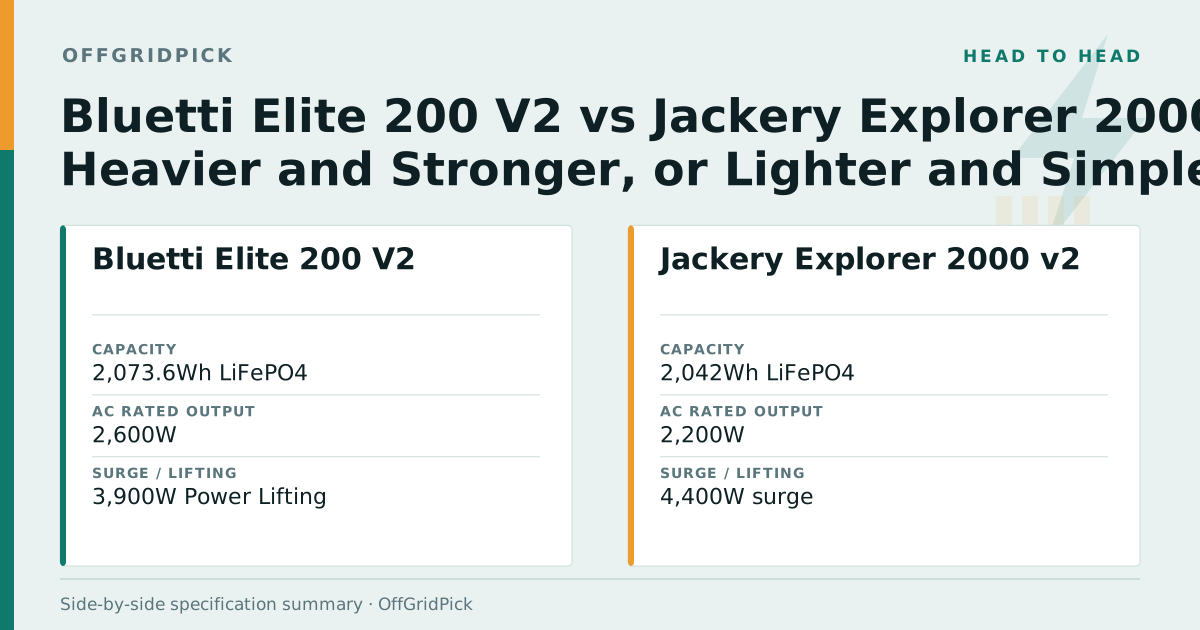
Both of these land within about 30Wh of each other on capacity, which is close enough to call identical. Everything after that number diverges hard. One is built to anchor a solar system; the other is built to be picked up. Here’s how to tell which one you actually want.
Quick Answer
Get the Bluetti Elite 200 V2 if the station is going to sit somewhere and work — it takes 1,000W of solar input against the Jackery’s 400W, pushes 2,600W continuous instead of 2,200W, adds a fourth AC outlet, and carries a 6,000+ cycle rating measured to 80% capacity. Get the Jackery Explorer 2000 v2 if you’ll move it often or want the higher surge ceiling: it’s about 14 pounds lighter, its 4,400W surge tops the Bluetti’s 3,900W Power Lifting figure, and it runs notably quiet in silent charging mode. The Bluetti is the better system component; the Jackery is the better piece of luggage.
Spec Comparison
| Spec | Bluetti Elite 200 V2 | Jackery Explorer 2000 v2 |
|---|---|---|
| Capacity | 2,073.6Wh LiFePO4 | 2,042Wh LiFePO4 |
| AC Rated Output | 2,600W | 2,200W |
| Surge / Lifting | 3,900W Power Lifting | 4,400W surge |
| Max Solar Input | 1,000W | 400W |
| Max AC Input | 1,800W | Not published as a single figure |
| Wall Charge | About 1.1 hours to 80%, ~1.4 hours full | About 1.7 hours full |
| UPS Switchover | 15ms or less | Under 20ms |
| Cycle Rating | 6,000+ cycles to 80% | 4,000 cycles to 70%+ |
| AC Outlets | 4 | 3 |
| USB-C | 2 x 100W | 1 x 100W, 1 x 30W |
| USB-A | 2 x 15W | Yes |
| Weight | 53.4 lb (24.2 kg) | 39.5 lb (17.9 kg) |
| Noise | — | Under 30dB in silent charging mode |
| Expansion Battery | Supported | Not supported |
| Warranty | 5 years | 3 + 2 years |
Check current listings for both: Bluetti Elite 200 V2 and Jackery Explorer 2000 v2.
The 14 Pounds Are Not a Rounding Error
53.4 pounds versus 39.5 pounds is the difference between a two-hand deliberate lift and a grab-and-go. At the Jackery’s weight, one reasonably fit adult moves it from the garage to the car without planning the maneuver. At the Bluetti’s weight, you start thinking about where to set it down before you pick it up.
That’s not a knock on Bluetti — the extra mass buys a bigger inverter and a heavier-duty charge controller. But be honest about your usage pattern. A station that lives in a closet and comes out twice a year during outages can weigh whatever it wants. A station that goes camping every third weekend gets used more if it’s lighter. If portability is the dominant factor, our lightweight station guide covers the class below this one, where the gap becomes even more dramatic.
Solar Input: 1,000W vs 400W
This is the widest gap on the entire table and the one most buyers underestimate.
The Elite 200 V2 accepts 1,000W of solar across a 12V–60V window, per Bluetti’s Elite 200 V2 specifications. The Explorer 2000 v2 caps at 400W, as Jackery’s own product page confirms. That means a 400W array — say, two 200W folding solar panels — completely saturates the Jackery’s input while using less than half the Bluetti’s. Add a third panel and the Jackery gains nothing at all.
Why does Jackery cap it there? Because the Explorer 2000 v2 is designed around fast wall charging as the primary refill method, with solar as a supplement. That’s a coherent design philosophy, and for people who charge at home before a trip and top up in the field, 400W is plenty. It only becomes a limitation if you intend to run genuinely off-grid for a week, where solar is your only source and every clipped watt is one you don’t get back — and since panels seldom hit their rated output anyway, for the reasons the Department of Energy sets out on solar performance and efficiency, headroom on the input side is worth more than it looks on paper.
If you’re going Jackery anyway, our Jackery panel pairing guide explains how to hit that 400W ceiling efficiently without overbuying. If you’re building a bigger array, our camping solar setup guide walks through matching panels to input limits properly.
Output: Steady Power vs Startup Spikes
The Bluetti delivers more sustained wattage — 2,600W against 2,200W. That 400W margin is meaningful when you stack loads. Two appliances that individually fit under 2,200W may not fit together; under 2,600W they might.
The Jackery, though, has the higher instantaneous ceiling at 4,400W surge versus the Bluetti’s 3,900W Power Lifting rating. These two numbers measure slightly different things — Bluetti’s Power Lifting works by reducing delivered power to resistive loads so a high-rated device can run at all, while a surge rating describes a brief tolerated spike. For motor startup specifically, the surge number is the one that matters.
So: heavy simultaneous loads favor the Bluetti; single high-draw devices that spike on startup favor the Jackery. A shop vac or a compressor is the classic case for the second column. See our 2000W output roundup for how this class handles typical tool loads.
Which One for Which Job
RV and trailer use: Bluetti, in most builds. The fourth AC outlet, the higher continuous output, and the ability to actually use a rooftop array’s full production all point one way. Weight is less of a factor when the unit is strapped down anyway. Our RV station guide has more context.
Car camping and tailgating: Jackery. It’s the one you’ll carry without complaint, the silent charging mode keeps a quiet campsite quiet, and 2,200W covers everything a normal campsite throws at it. Our tailgating picks cover the accessory side.
Home backup: Close, with an edge to Bluetti. The 6,000+ cycle rating and expansion battery support mean the system can grow as your definition of “essential loads” grows. The Jackery is simpler and lighter but has no expansion path — what you buy is what you’ll always have. Our home backup guide covers sizing.
Long off-grid stretches: Bluetti, without much argument. Solar input is the binding constraint when you’re out for more than a few days, and 1,000W versus 400W decides it.
FAQ
Is the Bluetti Elite 200 V2 worth the extra weight over the Jackery Explorer 2000 v2? If you’re building a solar system or need 2,600W continuous, yes — you’re paying those 14 pounds for real capability. If you mostly charge from the wall and carry the unit yourself, no. The Jackery gives you effectively the same capacity in a package you’ll actually use more often.
Which one charges faster? The Bluetti. It reaches 80% in roughly 1.1 hours and full in about 1.4 hours from AC, while the Jackery takes around 1.7 hours to full. Both are fast enough that overnight charging is unnecessary.
Can I add an expansion battery to the Jackery Explorer 2000 v2? No. The Explorer 2000 v2 does not support expansion batteries — its capacity is fixed. The Elite 200 V2 does support expansion, which is the stronger argument for it if you expect your needs to grow. Our expandable station guide lists the platforms worth building on.
Which is quieter? Jackery publishes a silent charging mode rated under 30dB, which is a specific and unusual claim in this class. Both units run fans under heavy load, but the Jackery’s quiet charging is a genuine advantage if the station shares a room or a tent site with sleeping people.
Do both have a real UPS function? Yes. The Bluetti switches in 15ms or less, the Jackery in under 20ms. Both are comfortably inside the window that keeps routers, desktops, and NAS units running through a cut. Neither should decide the purchase.
Conclusion
Same capacity, opposite design briefs. The Elite 200 V2 is a component — you install it, feed it a big array, and let it carry heavy sustained loads for years on a cycle rating nothing else in the class matches. The Explorer 2000 v2 is a tool — you pick it up, take it somewhere, and it runs quietly without asking much of you.
Neither one is a compromise version of the other, which is why the spec sheets look so similar and the ownership experiences don’t. If you want the full brand-level view, our Jackery vs Bluetti comparison covers ecosystem and support differences, and the Explorer 2000 v2 review goes deeper on the Jackery specifically. Weighing a third option? EcoFlow’s DELTA 3 Max against the Elite 200 V2 is the other matchup worth reading in this class.