EcoFlow RIVER 3 Plus vs Anker SOLIX C300: The Best Under-10-Pound Power Station?
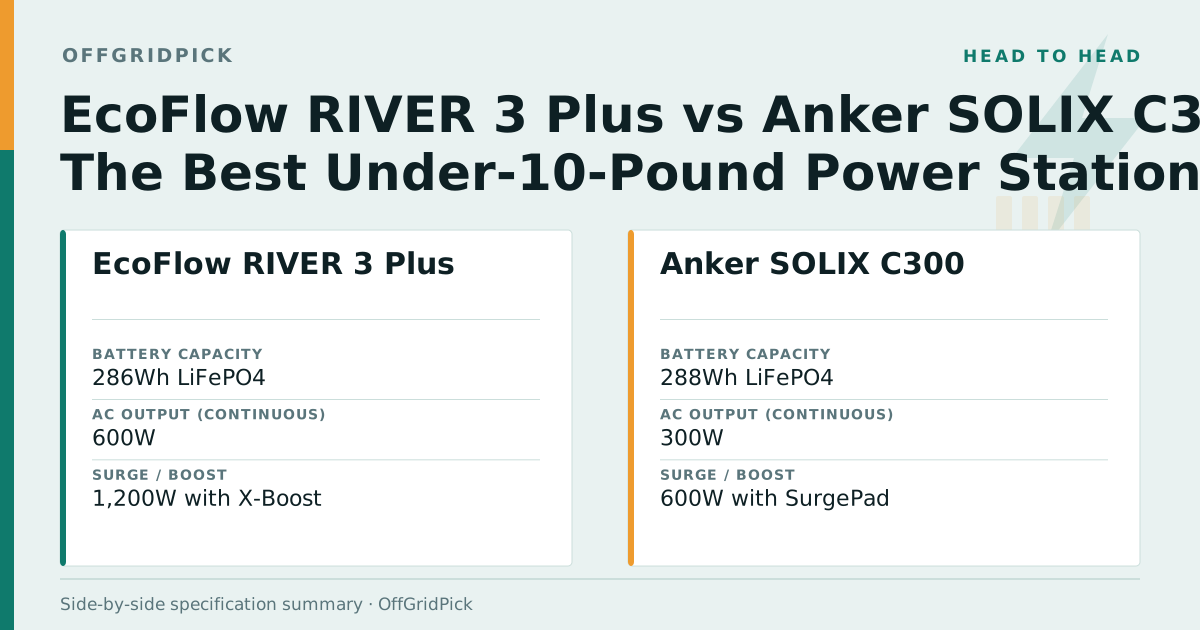
Two Wh apart. That’s the entire capacity gap between the EcoFlow RIVER 3 Plus at 286Wh and the Anker SOLIX C300 at 288Wh — which makes them look interchangeable on a spec sheet. They aren’t. The inverter in one is twice the size of the other, and only one of them can grow.
Quick Answer
Get the EcoFlow RIVER 3 Plus if you need to run anything with a plug that isn’t a charger: 600W continuous (1,200W with X-Boost) versus the C300’s 300W, plus an expansion battery that takes it to 858Wh. Get the Anker SOLIX C300 if weight is the deciding factor and your loads are USB-scale: 8.3 lb against 10.4 lb, a genuinely pocket-sized footprint, and 140W two-way USB-C charging that makes it a superb laptop-and-camera battery. Same energy stored, very different jobs.
Spec Comparison
| Spec | EcoFlow RIVER 3 Plus | Anker SOLIX C300 |
|---|---|---|
| Battery capacity | 286Wh LiFePO4 | 288Wh LiFePO4 |
| AC output (continuous) | 600W | 300W |
| Surge / boost | 1,200W with X-Boost | 600W with SurgePad |
| Weight | 10.4 lb | 8.3 lb |
| Expansion battery | Yes, to 858Wh | Not supported |
| Max solar input | 220W | 100W |
| AC recharge | Full in 1 hour | 0–80% in 50 minutes |
| Solar recharge | 1.5 hours | Longer, limited by 100W ceiling |
| UPS switchover | Under 10ms, all AC outlets protected | 10ms |
| USB-C | Output ports | 140W two-way fast charging |
| AC outlets | 3, all UPS-protected | Full-size AC outlets included |
| Total ports | 7 | Multiple USB-C, USB-A, car socket |
| Rated cycle life | 3,000 cycles to 80% | LFP, rated for roughly a decade |
| Noise | Under 30 dB | 25 dB at 3.3 ft |
| Warranty | 5 years | 5 years |
Check current listings: EcoFlow RIVER 3 Plus and Anker SOLIX C300.
The Inverter Gap Decides Most Purchases
Three hundred watts is a real ceiling. It comfortably covers laptops, camera batteries, drone chargers, a CPAP, LED lighting, a small fan, and a projector. It does not cover a coffee maker, an electric kettle, a hair dryer, a hot plate, a portable induction burner, or most power tools. Anker’s SurgePad extends the C300 to 600W for momentary spikes, which helps something like a small blender start, but it doesn’t change what the unit can run continuously.
Six hundred watts continuous on the RIVER 3 Plus roughly doubles the list. Add a full-size blender, a soldering iron, a small microwave in short bursts, a Starlink terminal alongside other gear, and most single-appliance kitchen tasks. EcoFlow’s X-Boost pushes to 1,200W for resistive heating appliances — kettles, small heaters, hair dryers — by lowering delivered voltage rather than raw wattage, a mechanism EcoFlow describes on the RIVER 3 Plus product page. It’s a workaround, not a full 1,200W inverter, but it genuinely widens what you can plug in at a campsite.
The practical question: at 286Wh of stored energy, do those bigger loads make sense anyway? A 600W kettle draws the entire battery down in under half an hour. The RIVER 3 Plus’s advantage isn’t that you’ll run heavy loads for long — it’s that you can run them at all, briefly, without the inverter refusing.
Weight, Size, and What “Portable” Means Here
Two pounds sounds trivial until you’re the one carrying it. The C300’s 8.3 lb is about as light as a genuinely useful AC power station gets in this class — it slides into a daypack, fits alongside a camera kit, and disappears into a vehicle storage bin. Anker also rates it at 25 dB at 3.3 feet, which is quiet enough that it won’t wake anyone in a tent.
The RIVER 3 Plus at 10.4 lb is still one-hand portable and still fits in a backpack, but it’s noticeably more of a commitment. Under 30 dB keeps it acceptable overnight as well.
Neither is a backpacking battery in the strict sense — for multi-day hiking you want something in the sub-2-pound power bank range. Our lightweight backpacking power station guide and small power stations for hiking cover that end of the spectrum. Both of these are car-camping, van, and emergency-kit units.
Expansion and Solar: The RIVER 3 Plus Pulls Away
The C300 is what it is, permanently: 288Wh, no expansion port, and a 100W solar input ceiling that means a full solar recharge takes most of a good day. Anker’s SOLIX C-series page is the place to confirm that ceiling, since retail listings vary on how they state it.
The RIVER 3 Plus accepts an expansion battery that brings total capacity to 858Wh — triple the base — and takes up to 220W of solar input, refilling from empty in around 1.5 hours under good conditions. That combination changes the unit’s category. A 286Wh station is a weekend accessory; an 858Wh station with 220W of solar intake can sustain a small off-grid setup indefinitely.
If there’s any chance you’ll want more capacity later, that expansion port is worth more than the two-pound weight penalty. Our expandable power station guide covers the wider modular market.
Where the C300 Wins Outright
Two things, and both are genuine.
140W two-way USB-C. The C300 charges and discharges over USB-C at up to 140W. That means it refills from a laptop charger you already own — no proprietary brick, no AC adapter in the bag — and it fast-charges a modern USB-C laptop at full speed on the way out. For a photographer, a remote worker, or anyone whose devices are all USB-C, this single feature can be worth more than the RIVER’s bigger inverter.
Footprint. At 8.3 lb, with full-size AC outlets, a car socket, and a stack of USB ports, it packs a lot of function into very little volume — and Anker rates it at 25 dB from a few feet away, so it stays unobtrusive overnight. It’s the unit you’ll actually bring, because packing it costs you nothing.
Both units run LiFePO4 chemistry with 5-year warranties and both offer 10ms UPS switching, so neither compromises on the fundamentals. Chemistry matters at this size — see our LiFePO4 power station guide for why.
Which Should You Buy?
Car camping with a camp kitchen. RIVER 3 Plus. The 600W inverter and X-Boost cover most single appliances; the C300 will refuse them.
Photography, video, and remote work. C300. The 140W two-way USB-C is purpose-built for this, and 288Wh of laptop and battery charging is plenty for a long shoot day.
Emergency kit for a power outage. RIVER 3 Plus, for the expansion option and the higher output. If the outage runs long, a bigger inverter and an add-on battery matter. Our emergency power station roundup covers what to prioritize.
Absolute minimum weight and bulk. C300. Nothing at this capacity packs smaller.
Comparing across the whole class. Our 200Wh roundup, the budget-tier roundup, and our EcoFlow RIVER 3 review cover the neighbors on both sides of these two.
FAQ
1. Is the EcoFlow RIVER 3 Plus worth it over the Anker SOLIX C300? Yes, if you need more than 300W of AC output or want the option to expand to 858Wh later. No, if your loads are laptops, cameras, phones, and lights — in that case the C300 does the same job two pounds lighter.
2. What is the lightest power station that can run AC appliances? Between these two, the C300 at 8.3 lb. It’s among the lightest units in this class with real AC outlets, though its 300W ceiling limits what those outlets can drive.
3. Does the Anker SOLIX C300 have an expansion battery? No. The C300 is a fixed 288Wh unit. If capacity growth matters, the RIVER 3 Plus and its 858Wh ceiling is the one to buy.
4. Can either one run a CPAP machine overnight? Both can. Most CPAP machines draw well under 100W without a heated humidifier, and roughly 286–288Wh covers a full night comfortably. The humidifier is the component that changes the math — the NHLBI’s explainer on CPAP therapy covers what it does — and switching it on cuts runtime substantially on either unit. Our CPAP power station guide covers the runtime math.
5. Which charges faster? The RIVER 3 Plus reaches a full charge in about an hour from AC and roughly 1.5 hours from 220W of solar. The C300 hits 80% in about 50 minutes from a wall outlet but is limited to 100W of solar input, so solar recharging takes considerably longer.
6. Why does the RIVER 3 Plus sometimes show 760W in listings? That figure refers to a boost or surge value in some retail listings. EcoFlow’s official continuous AC rating is 600W, with X-Boost extending to 1,200W for compatible resistive appliances. Buy against the 600W number.
Conclusion
Two nearly identical batteries wrapped around completely different intentions. The Anker SOLIX C300 is the travel unit — 8.3 lb, tiny, whisper-quiet, and built around 140W two-way USB-C for people whose gear all charges over USB-C anyway. The EcoFlow RIVER 3 Plus is the capable one — double the inverter, more than double the solar intake, and a path to 858Wh that makes it a genuine small off-grid system rather than a big power bank.
If your list of loads includes anything that plugs in and heats up, take the RIVER 3 Plus. If it’s all screens and batteries, the C300 saves you two pounds and a lot of pack space for exactly the same amount of stored energy.