Bluetti Elite 100 V2 vs Anker SOLIX C1000 Gen 2: The New 1kWh Benchmark
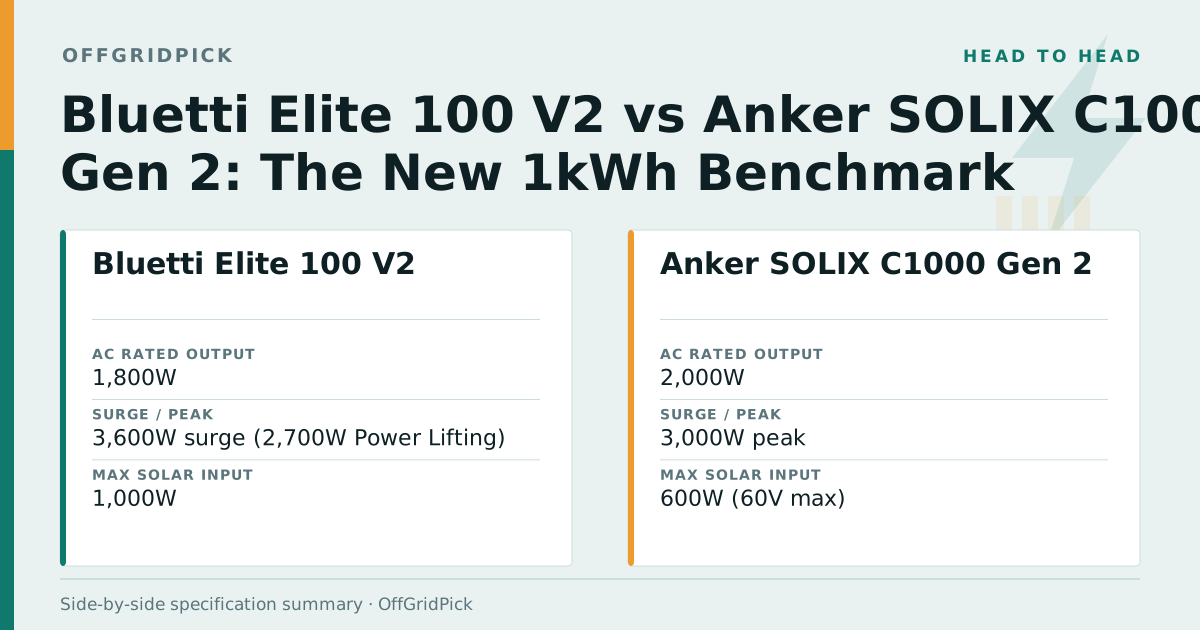
These two are the current state of the art in the 1kWh class, and they make the comparison unusually clean: same 1,024Wh LiFePO4 battery, same 4,000-cycle rating, same 10ms UPS switchover, and weights within half a pound of each other. When the fundamentals match this closely, the decision moves entirely to what surrounds the battery.
Quick Answer
Get the Bluetti Elite 100 V2 if you’re going to use solar or plug in more than two things at once — it accepts 1,000W of solar input against the Anker’s 600W, gives you four AC outlets instead of two, adds a second high-wattage USB-C port, and handles a higher 3,600W surge. Get the Anker SOLIX C1000 Gen 2 if raw output and refill speed rule: 2,000W continuous beats the Bluetti’s 1,800W, and a full recharge in 49 minutes beats roughly 70. There is no wrong answer here, only a mismatch between the unit and the job.
Spec Comparison
| Spec | Bluetti Elite 100 V2 | Anker SOLIX C1000 Gen 2 |
|---|---|---|
| Capacity | 1,024Wh LiFePO4 | 1,024Wh LiFePO4 |
| AC Rated Output | 1,800W | 2,000W |
| Surge / Peak | 3,600W surge (2,700W Power Lifting) | 3,000W peak |
| Max Solar Input | 1,000W | 600W (60V max) |
| Max AC Input | 1,200W | 1,600W (UltraFast) |
| Recharge to Full | About 70 minutes | 49 minutes |
| Charge to 80% | 45 minutes | — |
| UPS Switchover | 10ms or less | 10ms |
| Cycle Rating | 4,000+ cycles to 80% | 4,000 cycles to 80% |
| AC Outlets | 4 | 2 |
| USB-C | 2 (140W and 100W) | 1 (140W) |
| USB-A | 2 | 2 (12W combined) |
| Car Port | 1 (12V) | 1 (120W) |
| Extra DC | 2 barrel ports | — |
| Weight | 25 lb (11.5 kg) | 24.9 lb |
| Dimensions | 12.6 x 8.5 x 9.8 in | 15.12 x 8.19 x 9.61 in |
| Warranty / Life | 5 years | Rated for a 10-year service life |
Check current availability for both: Bluetti Elite 100 V2 and Anker SOLIX C1000 Gen 2.
Solar Input Is the Widest Gap
1,000W versus 600W is the biggest single difference on the sheet, and it’s the one that scales with how seriously you take off-grid use.
The Anker’s 600W ceiling comfortably covers three 200W portable solar panels — plenty for topping up a 1kWh battery over a long day. But the Bluetti’s 1,000W input means you can throw a much larger array at a 1kWh battery and refill it in a fraction of the time, which matters when you’re chasing a short weather window rather than a full day of sun. In a cloudy climate, the ability to capture more during brief clear spells is worth more than the raw number suggests.
If solar is incidental — you own a panel but mostly charge from the wall or a car — this gap costs you nothing. Our 100W panel guide and the foldable panel roundup cover what realistic arrays look like at this size.
Outlets: Four vs Two
The Anker C1000 Gen 2 gives you two AC outlets. The Bluetti Elite 100 V2 gives you four. That’s the difference most owners actually feel day to day.
Two outlets is enough for a laptop and a fan. It is not enough for a camp kitchen where a kettle, a string of lights, a fridge, and someone’s charger all want a socket at once, and the fix is dragging a power strip along. Four outlets means the station is the power strip.
Anker partly compensates with a total of ten ports across all types and a strong 140W USB-C, but Bluetti matches that USB-C and adds a second 100W one, plus a pair of DC barrel outputs the Anker doesn’t have. On sheer connectivity, the Elite 100 V2 is the more flexible unit. If port count is a priority across the class, our 1000Wh roundup ranks the field.
Output and Recharge: Anker’s Two Wins
The C1000 Gen 2 delivers 2,000W continuous against the Bluetti’s 1,800W. In this class that 200W is the margin between running a 1,500W space heater alongside a few small loads and tripping the inverter. If your load list has a single high-draw appliance you plan to run for hours, Anker is the safer pick.
Interestingly, the surge picture inverts. The Elite 100 V2 handles a 3,600W surge against the C1000 Gen 2’s 3,000W peak, plus a 2,700W Power Lifting mode that lets over-rated resistive devices run at reduced power. So Anker is better for sustained heavy draw and Bluetti is better for spiky startup loads — the same split that shows up one class up in the 2kWh matchups.
Recharge is a clearer Anker win. A 1,600W UltraFast input takes the C1000 Gen 2 from empty to full in 49 minutes. The Bluetti’s 1,200W input reaches 80% in 45 minutes and full in around 70. Both are fast enough that you’ll never plan around them, but Anker’s number is genuinely class-leading. Our fast-charging guide puts that in context against the wider market.
Shape, Size, and Where It Lives
Weight is a wash — 25 pounds versus 24.9. Shape isn’t. The Bluetti is the squarer, more compact box at 12.6 x 8.5 x 9.8 inches; the Anker is longer and lower at 15.12 x 8.19 x 9.61. Bluetti markets the Elite 100 V2 as 35% smaller than comparable units, and the volume math backs the direction of that claim even if the exact figure depends on which comparison you pick.
For a van cabinet or a packed trunk, the Bluetti’s proportions are usually easier to place. For a shelf or under a desk, the Anker’s lower profile can be the better fit. Measure the space you actually have — this decides more purchases than people admit. Our apartment power station guide covers indoor placement in more detail.
FAQ
Is the Bluetti Elite 100 V2 better than the Anker SOLIX C1000 Gen 2? Better for solar users and anyone who needs multiple AC outlets, thanks to 1,000W solar input and four sockets versus 600W and two. Worse if you need maximum continuous output or the fastest possible recharge, where the Anker’s 2,000W and 49-minute refill win. The batteries themselves are equivalent.
Which one runs a refrigerator longer? Neither, meaningfully. Both hold 1,024Wh of usable LiFePO4 capacity, so runtime on any given load is essentially identical. Runtime differences between these two come down to inverter efficiency, not capacity. Our fridge runtime guide walks through the math.
Is the Anker C1000 Gen 2 worth it over the older C1000? That’s a separate comparison with its own answer — the Gen 2 changed output, recharge time, and UPS switchover. Our Gen 2 vs Gen 1 breakdown covers it directly, and the full Gen 2 review goes deeper on the unit itself.
Do both work as a UPS for a computer or CPAP? Yes. Both switch in about 10ms, which is well inside the tolerance of desktops, routers, NAS units, and medical devices. For CPAP-specific sizing, our CPAP power station guide covers overnight runtime expectations at this capacity.
Which lasts longer before the battery degrades? Both are rated at 4,000 cycles to 80% original capacity, which is roughly a decade of regular use. Bluetti backs the Elite 100 V2 with a 5-year warranty; Anker rates the C1000 Gen 2 for a 10-year service life under its InfiniPower design. Longevity is not a deciding factor between these two.
Conclusion
This is what a mature product category looks like: two companies arriving at the same battery, the same cycle life, the same weight, and the same UPS speed, then differentiating on the parts that are actually cheap to change. Bluetti spent its budget on inputs and outputs — more solar, more sockets, more USB-C. Anker spent its on the inverter and charger — more continuous watts, faster refill.
Pick by whichever list you read twice. If it was the solar input and the outlet count, get the Elite 100 V2. If it was 2,000W and 49 minutes, get the C1000 Gen 2. For the brand-level view across the rest of both lineups, our Bluetti vs Anker comparison is the follow-up read, and our 1000W output guide covers what else competes at this size.